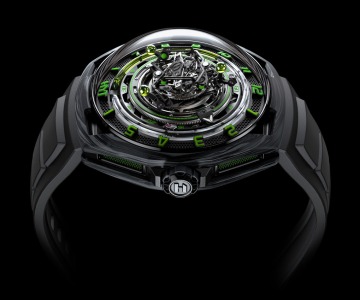
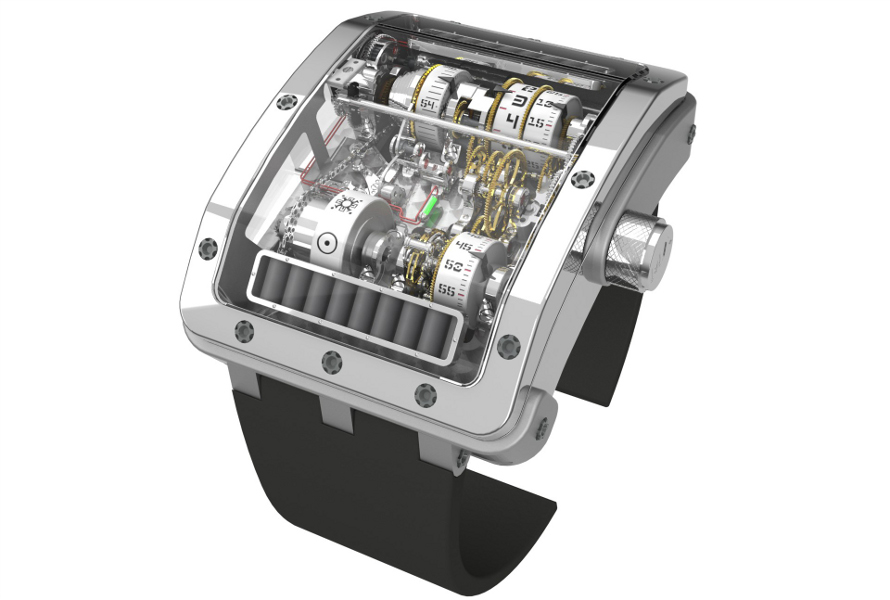
 Marc Alfieri, horloger avant-gardiste, est un des acteurs majeurs dans le déploiement des panneaux solaires en France. Cette expérience ajoutée à sa rencontre avec Jean-François Ruchonnet lui a donné l’idée de marier le mouvement spectaculaire de la Cabestan Winch Tourbillon Vertical à un système de remontage à énergie solaire, le tout adapté à une échelle miniaturisée jamais vue auparavant.
Le challenge était d’allier la micromécanique à des mini-capteurs photovoltaïques, générer, stocker puis exploiter l’énergie nécessaire afin d’assurer le remontage du mouvement de manière perpétuelle.
Marc Alfieri, qui installe en France de vastes surfaces de panneaux solaires générant 100 mégawatts d’électricité, a adapté cette même technologie à Sol Invictus pour produire seulement 100 milliwatts, soit un milliard de fois moins de puissance. Pour réaliser cet exploit, il a fait appel à L’INES (l’Institut National de l’Energie Solaire) qui a développé une technique révolutionnaire en combinant des cristaux de silicium pour fabriquer des panneaux solaires à haut rendement. Extrêmement efficaces, ils sont particulièrement adaptés à l’utilisation pour des petites surfaces et à capter de faibles sources lumineuses. Sol Invictus aura l’honneur d’être la première utilisation commerciale au monde de cette technologie de pointe.
Deux micromoteurs brushless, issus du milieu médical, au diamètre de 1.9 mm et longs de 5.5 mm, ont été choisis pour le remontage et pour la mise à l’heure. Un contrôleur miniaturisé règle et amplifie la charge électrique, gère les deux micromoteurs via un oscillateur programmable et assure la direction et la vitesse. Enfin, pour déclencher les moteurs, une ampoule à contact bi-lame est employée pour ouvrir et fermer le circuit électrique. Le résultat est un système de puissance perpétuelle né d’une combinaison fascinante des derniers développements issus de la recherche sur les semiconducteurs et de la technologie électromécanique du 19ème siècle.
Jean-François Ruchonnet a travaillé avec Marc Alfieri sur le design. Au cœur de la pièce, le spectaculaire mouvement du Cabestan Winch Tourbillon Vertical. A 12H00 et 6H00, il a placé, de manière équilibrée, les panneaux solaires en les a incorporant dans d’ingénieux cadres montés sur la platine avec pivots. Les micromoteurs et la batterie rechargeable lithium-ion ont été positionnés pour être discrètement visibles sous les cellules solaires. L’ampoule à contact bi-lame, héritée des découvertes du physicien Léon Foucault au 19ème siècle, est parfaitement visible au milieu du mouvement. Le mécanisme complexe qui lie la couronne aux systèmes de remontage et de mise à l’heure comporte un axe long de 30 mm qui traverse le mouvement dans sa largeur. Enfin, la carrure est inspirée des créations de Marc Alfieri, mais Jean-François Ruchonnet a choisi de lui donner une forme courbée pour être très agréable au poignet. Elle comporte également une simple glace courbée en pyrex thermoformé, une fenêtre latérale à 9H00 et un fond en saphir afin d’accroître la visibilité de cet incroyable mécanisme.
Eric Coudray s’est chargé d’intégrer l’ensemble de cette technologie et d’assurer le fonctionnement parfait de Sol Invictus. Dans ce but, il a élaboré un système de détection automatique du besoin de remontage du barillet. En fin de réserve de marche, une bascule positionne un aimant devant l’ampoule à contact bi-lame, ferme le circuit électrique et déclenche le remontage. L’énergie cinétique induite par le moteur passe à travers un différentiel et remonte le barillet en agissant sur la fusée et la chaine. Le remontage achevé, l’aimant bascule de nouveau pour ouvrir le contact et couper l’alimentation du moteur. La mise à l’heure fonctionne de manière identique avec son propre moteur. Une couronne multifonctions et son mécanisme débrayable permettent d’actionner le remontage de manière électromécanique ou manuelle, et la mise à l’heure de façon électromécanique.
Sol Invictus : Cabestan featuring Marc Alfieri
Depuis 7000 ans, le soleil est au cœur du temps mais, jamais, n’a-t-il été exploité pour assurer la marche perpétuelle d’un garde-temps mécanique. Sol Invictus rompt avec les codes de la haute horlogerie traditionnelle et repousse les limites de l’imagination. Le mariage d’une idée de génie et d’un mouvement spectaculaire est devenu réalité : une œuvre d’art mécanique destinée aux collectionneurs les plus exigeants. L’art horloger poussé à l’extrême. Le résultat exceptionnel d’une synergie entre trois horlogers, emblématique de la nouvelle génération horlogère.
Sol Invictus
- Indications
- Heures, minutes, secondes affichés sur trois tambours rotatifs gravés
- Réserve de marche affiche sur un tambour rotatif gravé
- Mouvement
- Mouvement mécanique Calibre CAB EC 101 à ancre suisse
- Tourbillon mécanique réglé sur 6 positions avec force constante en provenance du système de chaine et fusée
- Fréquence: 21 600 alt/h ou 3 HZ
- Spiral Bréguet ; piton de Genève
- Amplitude du balancier : 240°
- X rubies
- Chaine en acier de 160 mm composé de 235 maillons et 156 rivets
- Remontage et mise à l’heure par la couronne déployante ou remontage automatique par system à puissance solaire
- Système de rouages verticales et différentiel vertical
- Carrure en titane grade 5 avec fenêtre latérale (autres matériaux disponible sur demande)
- Système de puissance solaire
- Système de génération de puissance à énergie solaire
- Deux cellules solaires développés utilisant une technologie propriétaire de L’INES (Institut national de l’énergie solaire)
- Interrupteur automatique électromécanique avec contact bi-lame actionné par un aimant
- Batteries lithium-ion
- Circuit contrôleur /oscillateur programmable
- Deux brushless dc micromoteurs pour le remontage et la mise à l’heure