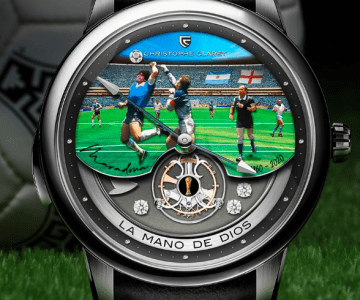
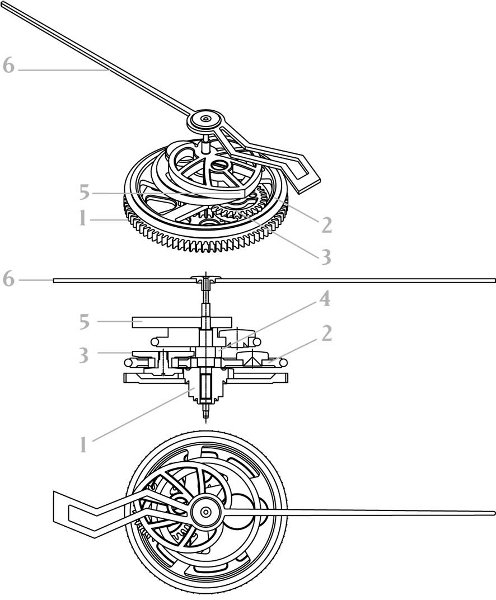
L’innovation majeure offerte par la DualTow tient dans une fonction chronographe mono poussoir fonctionnant grâce à trois planétaires, chacun d’entre eux présentant la même structure.
Directement reliée au mouvement, la roue d’entrée des planétaires (1) est entrainée en continu. Connecté à elle, un porte-satellite (2) pivote sur l’axe de la roue d’entrée sur lequel se meuvent à leur tour deux satellites (3). Placés sur un axe parallèle à celui de la roue d’entrée, ces derniers l’engrènent avec la roue de sortie (4) située, elle, dans la partie supérieure du porte-satellite. Au sommet, une came (5) surmontée d’une aiguille (6) est fixée sur le même axe que la roue d’entrée, solidaire de la roue de sortie, et permet la remise à zéro du chronographe.
La roue d’entrée transmet son mouvement de deux manières. Lorsque la rotation de l’aiguille est bloquée, elle entraine le porte-satellite qui tourne alors dans le vide. Ce fonctionnement correspond aux positions stop et reset du chronographe. En revanche, quand le chronographe est en position start, le porte-satellite est bloqué et le mouvement de rotation de la roue d’entrée est transmis à l’aiguille.
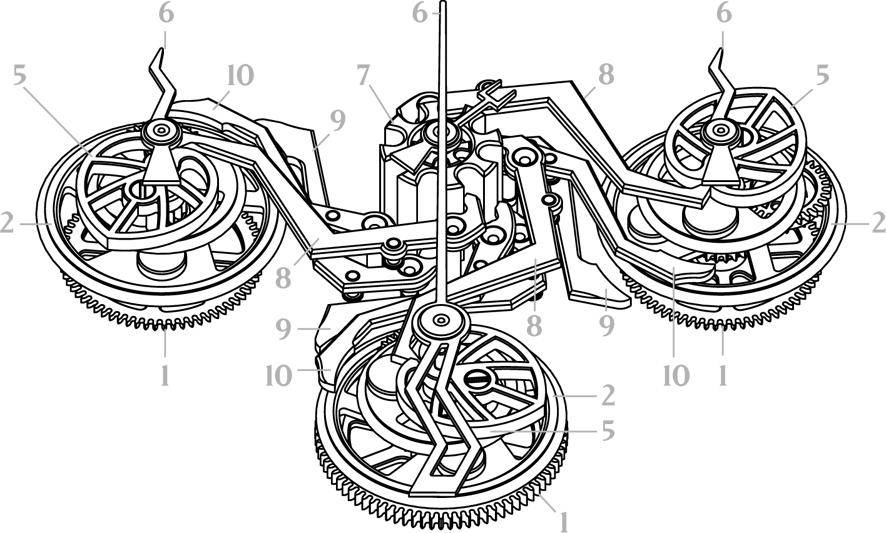
Lorsque le chronographe est déclenché, la roue à colonnes (7) avance d’un pas et soulève les marteaux de remise à zéro (8). Puis, les freins de start (9) tombent et bloquent les trois porte-satellites (2). Les aiguilles (6) commencent alors immédiatement à tourner puisque l’énergie est retransmise des roues d’entrée (1) aux roues de sortie (4). La seconde pression arrête la marche du mécanisme. La roue à colonne avance d’un nouveau pas et soulève les freins de start, ce qui libère les porte-satellites. Puis, les freins de stop (10) tombent et bloquent un disque solidaire des aiguilles. Lors de la troisième pression, la roue à colonnes avance encore d’un pas. Les freins de stop se lèvent et libèrent la roue de sortie. Les marteaux tombent ensuite sur les cames (5) et les font tourner jusqu’à ce que les aiguilles reviennent à zéro. Le cycle du chronographe est alors terminé et le système paré pour une prochaine mesure.