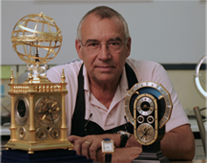
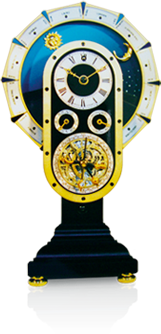
 C’est dans la province pittoresque du village de Joure dans la région hollandaise de Friesland que Christiaan van der Klaauw a commencer à concevoir ses gardes temps astronomiques au début des années 70. Il a reçut son éducation dans l’institut fondé par le physicien Heike Kamerlingh Onne, qui fut le premier à réussir à liquéfier l’hélium. Il continua son apprentissage au près du plus ancien observatoire dans le monde, fondée en 1633. Ce fut d’ailleurs l’une de ses plus grandes inspirations pour la conception de ses gardes temps. En 1990, Christiaan van der Klaauw a présenté un véritable chef-d’œuvre: l’horloge astronomique. Cette horloge a été l’une des raisons pour lesquelles il a été invité à devenir membre de l’Académie Horlogère des Créateurs Indépendants (AHCI).
En 1992, Christiaan van der Klaauw a remporté la prestigieuse médaille d’or à la foire de Bâle pour son travail entrepris sur son modèle la «Pendule Variable».
Concernant ses montres bracelets, Christiaan van der Klaauw a puisé son inspiration dans l’astronomie, tout comme il le fit avec ses horloges. Sa première montre-bracelet fut le modèle «Satellite du Monde».
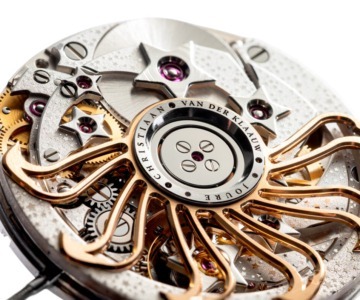
A la fin des années 90 Christiaan van der Klaauw a conçût l’une de ses montres la plus ingénieuse: le Planétarium. Inspiré par les astronomes comme Christiaan Huygens et Eise Eisinga, il a réussit à concevoir un planétarium dans une montre, ce qui en fait le plus petit planétarium au monde. . A la foire de Bâle en 2009, Christiaan van der Klaauw a surpris de nouveau l’univers des montres avec son «Tourbillon». Ce chef-d’œuvre a prouvé, une fois de plus, que Christiaan van der Klaauw fait partie de l’élite des horlogers.
Quelques modèles de la collection
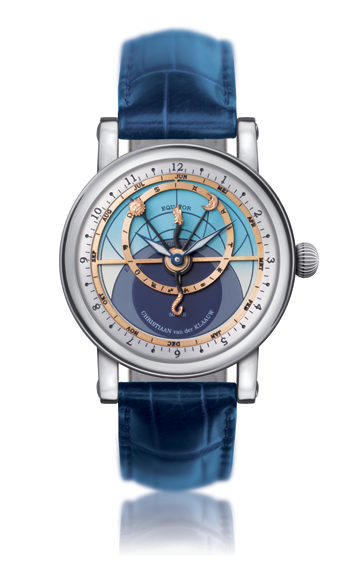 |
CK ASTROLABIUM
Soleil et la Lune sur l’écliptique, la position du noeud ascendant et descendant L’aiguille du soleil donne la date, mais également l’heure solaire. |
 |
CK PLANETARIUM Ce chef-d’œuvre est une démonstration ultime de la précision et l’artisanat traditionnel. La montre est équipée du plus petit planétarium au monde et donne non seulement l’heure, la date et le mois, mais aussi les orbites de Mercure, Vénus, Terre, Mars, Jupiter et Saturne autour du Soleil. |
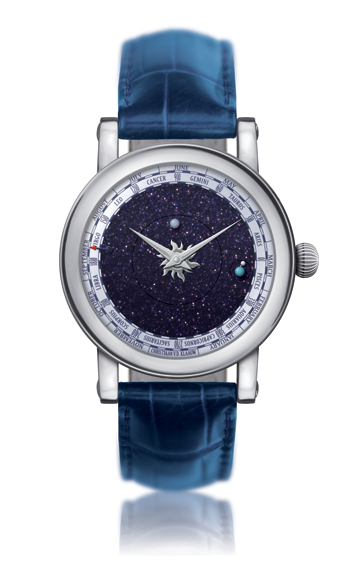 |
CK VENUS Outre l’indication du temps, le modèle «Vénus» indique la date et le signe du zodiaque dans lequel le Soleil se trouve. La position de Vénus, de la Terre et de la Lune sont également indiqués sur un magnifique cadran.
|