 Nord Zeitmaschine est né en 1997 à l’initiative de Daniel Nebel, horloger installé au Nord du Jura Suisse. Après avoir longuement étudié les cadrans de plusieurs montres mécaniques, Nebel Daniel remarqua que l’élément indicateur du temps tourne toujours autour d’un axe fixe. Cherchant une nouvelle forme d’affichage sans aucun centre de rotation fixe il donna naissance au modèle Variocurve le 5ème modèle de sa collection.


Il s’est d’abord intéressé aux systèmes de leviers mais ce fut sans succès. Ce n’est qu’après d’innombrables essais simulés qu’il développa une solution sous le principe de deux compteurs-rotatifs excentriques. Après avoir déterminé la position correcte des pivots et la longueur des leviers, la trajectoire suivie par l’aiguille était en parfaite adéquation avec l’esprit imaginatif de son créateur.Le résultat est exceptionnel: Pendant les 60 minutes, l’aiguille des minutes, à des vitesses différentes, se déplace le long d’un chemin avec des courbes différentes, le nom du modèle devient alors une évidence.
Une création à suivre lors du salon Baselworld 2011 qui débute le 24 mars.

- Mouvement:
- Nord N2 Minutes Variocurve / Affichage des minutes avec double segment / Heures décentralisées / Date.
- 25 rubis et 5 roulements à billes.
- Les pièces “glissantes” que l’aiguille des minutes font produites à partir d’ARCAP (Alliages cuivreux).
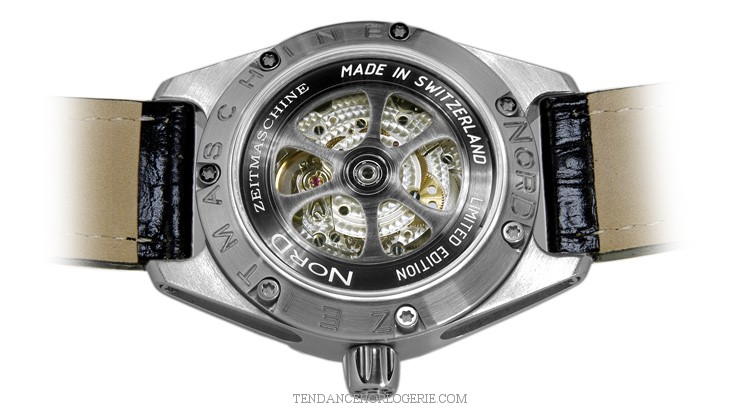
- Rotor en disque ajouré visible à travers le fond.
- 28800 alternances par heure
- Réserve de marche 42 h / base ETA 2824
- Boitier:
- en acier inoxydable
- lunette et verre sappir au dos, visée
- Couronne à double joints toriques
- Dimensions:
- diamètre: 43,6 mm
- hauteur: 15,8 mm
- Poids: 110 Grammes
- Lunette:
- Face: verre saphir bombé / plat 1,5 mm à 2,5 mm
- fond: verre saphir plat 1,8 mm
- Etanchéité: 10 ATM (100 mètres)
- Edition limitée:
- V1 limitée à 97 pièces, numérotées
- V2 limitée à 97 pièces, numérotées
- V3 limitée à 97 pièces, numérotées
- Versions:
- V1 pièces mécanique couché: rhodium blanc / or noir
- V2 pièces mécanique couché: rhodium blanc / or rose
- V3 pièces mécanique couché: rhodium blanc / or jaune
- Bracelet: bracelet en cuir de veau, 22mm large