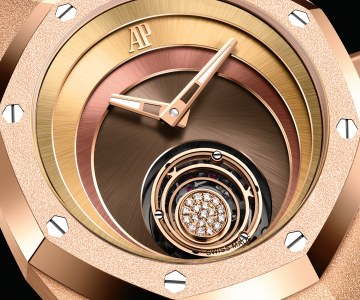
Historiquement, la Royal Oak Offshore est la grande parmi les grandes. Disproportionnée ? Titanesque ? Lors de sa création, en 1992, certains sont même allés jusqu’à dire qu’elle portait atteinte au bon goût. Eh bien, elle fut une pionnière ! Son design reprenait la forme vigoureuse de la Royal Oak, ce fameux octogone qui, en 1972, avait jeté le trouble dans le paysage paisible des montres rondes et classiques. Mais, vingt ans plus tard, la Royal Oak Offshore était plus robuste et plus masculine encore. Elle a donné son coup d’envoi au trend des montres de grande taille, trend qui n’a cessé, depuis, de creuser son sillon. Aujourd’hui, la collection Royal Oak Offshore réaffirme sa suprématie : le boîtier du nouveau trio mesure pas moins de quarante-quatre millimètres.

Dans chacune des trois déclinaisons, le boîtier joue la carte du binôme de matières. La céramique s’y associe, dans la première avec l’acier, dans la deuxième avec le carbone forgé, dans la troisième avec l’or rose. Le carbone forgé est un matériau emprunté à l’aéronautique que la Manufacture Audemars Piguet a été la première à introduire dans la Haute Horlogerie. Si la céramique a été retenue pour la lunette – la partie de la montre la plus exposée aux chocs et par conséquent aux rayures –, c’est à cause de sa résistance et de sa dureté. Le degré de finition appliqué à ce matériau mérite d’être souligné car, si l’horlogerie affectionne particulièrement ce matériau, rares sont ceux qui le terminent avant tant de soins. Des meules diamantées enlèvent des centièmes de matière de sorte à obtenir la même finesse de détails que sur l’acier, mais il s’agit ici de multiplier les opérations, autrement plus délicates et beaucoup plus gourmandes en temps.
Le contraste des matériaux permet de souligner la prestance des carrures quarantequatre millimètres. En somme, avec leur surface animée d’un décor satiné vertical et leurs biseaux polis, les lunettes en céramique retrempent le caractère de l’octogone. Celui-ci est ponctué de ses huit vis hexagonales en acier poli, comme le prescrivent les codes de la collection. Il est reconnaissable entre mille, toujours imité mais jamais égalé !
Le flanc droit de la montre a été l’objet d’attentions particulières. Les protège-poussoirs ne font pas partie du boîtier. Ils constituent au contraire deux pièces distinctes, rapportées au boîtier par quatre vis apparentes. Les poussoirs, de même, se composent de deux parties : une base et une coiffe qui sert de surface de contact. La construction est donc des plus complexes et nécessite un nombre élevé d’opérations, ce d’autant plus que ces pièces abondent en finitions. Les protège-poussoirs sont microbillés et satinés, 2 tandis que, côté poussoirs, la base est microbillée avec coiffe satinée et polie. Ainsi, il s’agit de bien plus que d’un simple changement de taille. C’est toute l’esthétique du boîtier qui a été retravaillée. Avec la netteté de ses arêtes, il impose un chronographe aux lignes tendues, sculpté, d’où se dégagent assurance, efficacité et haute technicité.