
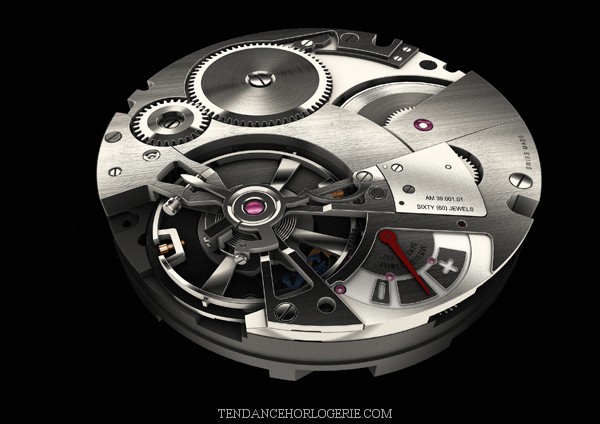
 Le premier mouvement antoine martin reflète les riches connaissances que son créateur, martin braun, a accumulées au cours de 30 ans d’expérience horlogère. perfectionné en plusieurs points – par des développements logiques et des inventions novatrices – ce mouvement est un chef d’œuvre technologique de 39.5 x 8 mm.
La création du nouveau mouvement est le résultat de longues années d’étude approfondie de l’échappement à ancre suisse avec ses fonctionnements et processus dynamiques. L’échappement à ancre suisse est le type d’échappement le plus couramment utilisé dans les montres-bracelets modernes. Il fut inventé en 1757 par Thomas Mudge, un génie qui parvint à adapter l’échappement à ancre classique à des montres portables. Georges Auguste Leschot, inventeur du tirage, a amélioré le système en 1825. Depuis, l’échappement à ancre suisse n’a pratiquement plus changé.
ECHAPPEMENT HPE
Pendant plusieurs années, Martin Braun a réfléchi à la possibilité de perfectionner l’échappement à ancre suisse sur ces propres mouvements de montre. Malheureusement, ce dont il rêvait n’était pas réalisable par les techniques et procédés de production classiques. Enfin, la mise en œuvre du silicium dans l’horlogerie lui a permis d’y parvenir. Son échappement modifié porte le nom de «High Performance Escapement», soit HPE. Depuis toujours, la détermination des angles utilisés dans l’échappement à ancre suisse était le résultat d’un compromis entre l’efficacité et la teneur en huile assurée par capillarité pour certains angles. Désormais, plus besoin de ce compromis! Un échappement dont les parties sont principalement constituées de silicium peut se passer de lubrifiants. Et le nouveau mouvement peut se flatter d’une efficience de 100%! En outre, en modifiant les angles, les plans d’impulsion de la roue d’ancre et les dents incurvées, ainsi qu’en redessinant les palettes, un gain énergétique de 8% a pu être réalisé. Enfin, l’optimisation de la cheville de plateau, en silicium, a permis d’obtenir encore 1% supplémentaire. Résultat de cette révision totale de l’échappement à ancre suisse: une amplitude passant de 300° à presque 330° si l’on compare le nouvel échappement à la construction traditionnelle.
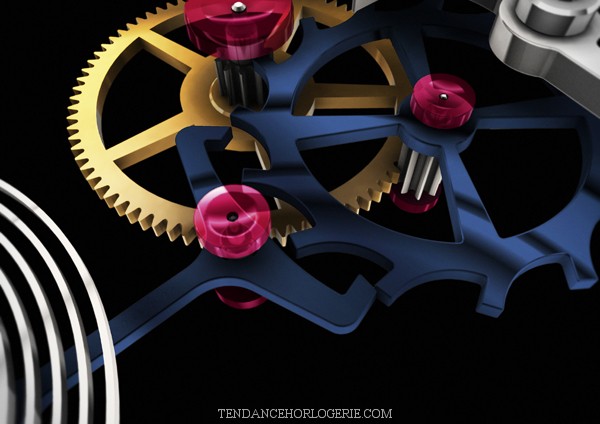
FUSIONNER ÉPOQUES ET TEMPS
Le calibre AM 39.001 relie les procédés de production modernes à l’époque des mouvements horlogers mécaniques les plus merveilleux et les plus élégants ayant jamais existé: le début des années 1900, jusqu’à nos jours reconnu comme le début des temps modernes. Le nouveau mouvement met en scène son cœur animé – qui est en même temps son plus beau composant – le balancier. Après un passage dans l’art horloger durant lequel des balanciers simples, standardisés se dissimulaient dans les montres-bracelets plutôt que de se montrer, ANTOINE MARTIN remet de nouveau en lumière ce composant technique fascinant. Fabriqué en titane high-tech grade 5 – dont la fonction primordiale est la stabilisation de l’amplitude – le balancier du AM 39.001 est de grandes dimensions: son diamètre mesure 17,5 mm. Sans raquette, son dispositif de régulation doté d’un spiral oscillant librement, permet d’effectuer le réglage au moyen de deux petites vis en or. Ce balancier est en même temps l’un des plus grands jamais mis en œuvre avec ce type d’échappement. Soulignant ses impressionnantes dimensions et sa marche infaillible, le balancier effectue 18 000 semi-oscillations par heure (2.5 Hz). Ce rythme classique révèle non seulement le gabarit du balancier mais aussi le calme majestueux avec lequel il assure sa tâche. Du point de vue technique, la grande taille fait parfaitement sens: il en résulte une énergie cinétique plus importante. De plus, si un choc vient ébranler le mouvement, un balancier de grande taille conserve mieux l’amplitude souhaitée qu’un petit balancier et permet donc d’éviter que le choc ne modifie la marche.
AERODYNAMIC AMPLITUDE STABILIZATION
En outre, le mouvement ANTOINE MARTIN est doté d’une autre innovation permettant de stabiliser son amplitude: l’ADAS (Aerodynamic Amplitude Stabilization). Il s’agit d’un dispositif sophistiqué comprenant une came complexe, commandée par l’indicateur de la réserve de marche. Lorsque la montre est entièrement remontée, cette came se met à se déplacer en direction du balancier jusqu’à approcher celleci de 0,01 mm. Les bras du balancier créent une petite «accumulation d’air» laquelle fonctionne tel un coussin de freinage. Alors que le ressort-moteur se détend, le système ADAS assure la stabilité de l’amplitude, quelle que soit la tension du ressort. Or, la stabilisation de l’amplitude est essentielle pour la régularité de la marche. Et c’est cette régularité qui assure au mouvement à remontage manuel un travail aussi précis que souhaité.
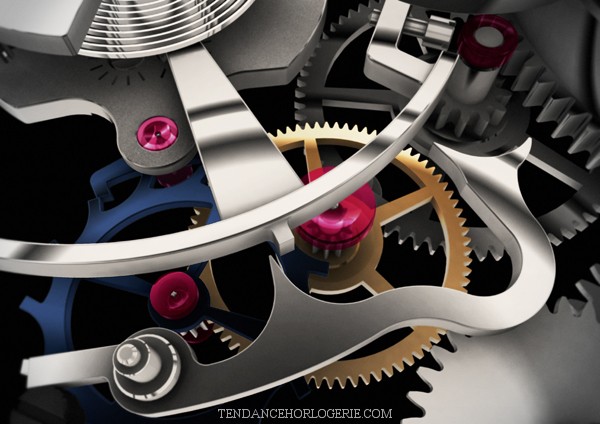
Aerodynamic Amplitude Stabilization
En dépit de la grande taille de son balancier, le nouveau mouvement à remontage manuel présente une réserve de marche de six jours (144 heures), ceci grâce à deux ressorts-moteur. Trois de ses 324 composants sont en silicium high-tech (l’ancre, la roue d’ancre et l’ellipse), et soixante en sont des rubis. Les pièces métalliques présentent une finition de haute qualité exécutée dans la meilleure tradition suisse. Ce mouvement ANTOINE MARTIN est un chef d’œuvre de haute horlogerie, robuste et résolument moderne. Le diamètre du boîtier recelant le calibre AM 39.001 mesure 46 mm. Contrairement à la plupart des montres modernes, sur le plan esthétique, ce boîtier paraît entièrement occupé par le mouvement, constituant ainsi une œuvre d’art intégrée, englobant à la perfection l’ensemble de ses affichages calendaires: calendrier perpétuel avec date, grande-date, mois, année bissextile et indicateur jour/nuit.